
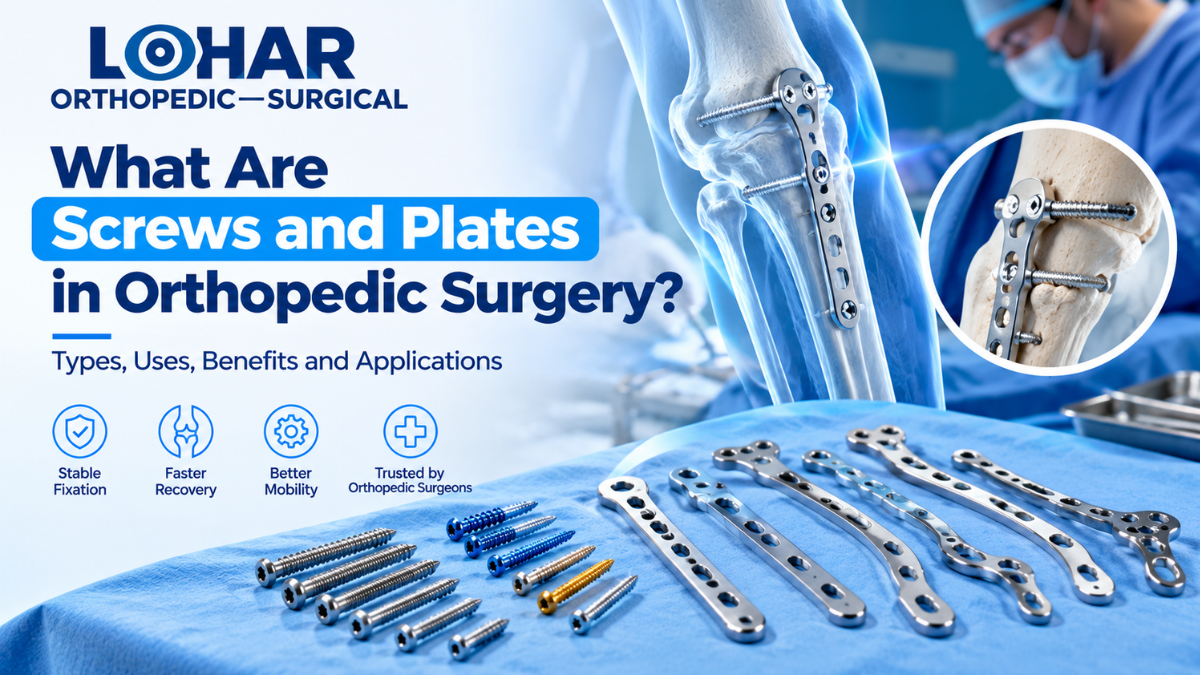
What Are Orthopedic Screws and Plates? Types, Design, Uses, and Applications
Orthopedic screws and plates are important surgical implants used in orthopedic procedures to help stabilize and support bones during fracture treatment and other reconstructive procedures. These implants are designed to work with the anatomy of the bone and can be used in different configurations depending on the fracture pattern, location, and surgical objective.
Orthopedic plates are generally shaped pieces of metal with specially designed holes that accommodate bone screws. The plate can be positioned along the surface of a bone, while screws are inserted through the plate and into the bone to help maintain the intended position of the bone fragments.
Orthopedic screws can also be used independently in certain procedures, depending on the type of fixation required. Different screw designs are available for different applications, including variations in diameter, length, thread configuration, head design, and intended fixation method.
For orthopedic surgeons, hospitals, surgical centers, medical-instrument distributors, and procurement teams, understanding the differences between orthopedic screws and plates is important when selecting implants and preparing orthopedic fixation systems.
This article explains what orthopedic screws and plates are, how they work, common types, designs, uses, applications, materials, important specifications, quality considerations, and what buyers should check before selecting them.
What Are Orthopedic Screws?
An orthopedic screw is a threaded surgical implant designed to provide fixation or stabilization of bone. Depending on its design and intended application, a screw can be used to hold bone fragments together, secure a plate to the bone, or provide fixation in other orthopedic procedures.
The screw consists of several important design elements, including the head, shaft, threads, and tip.
The exact configuration varies according to the intended application.
Important characteristics can include:
- Screw diameter
- Screw length
- Thread design
- Thread pitch
- Head configuration
- Drive type
- Tip design
- Material
- Intended fixation method
Different screw designs are selected according to the bone anatomy and fixation requirements.
What Are Orthopedic Plates?
An orthopedic plate is a specially designed surgical implant placed along the surface of a bone to assist with fracture fixation and stabilization.
Plates contain multiple holes through which screws can be inserted. The arrangement and design of these holes vary depending on the plate type.
Orthopedic plates can have different:
- Lengths
- Widths
- Thicknesses
- Curvatures
- Hole configurations
- Screw compatibility
- Anatomical profiles
Some plates are designed for particular anatomical regions, while others are available in more general configurations.
The correct plate depends on the fracture location, bone anatomy, fixation strategy, and surgeon’s preference.
How Do Orthopedic Screws and Plates Work Together?
Orthopedic screws and plates are frequently used as a fixation system.
A plate is positioned over the selected portion of bone, and appropriate screws are inserted through the plate holes into the bone.
Conceptually, the system works as:
Bone → Plate → Screw Fixation → Stabilization
The plate provides structural support while the screws secure the plate and, depending on the fixation technique and implant design, help maintain the desired relationship between bone fragments.
The exact fixation technique depends on the specific implant system, fracture pattern, anatomy, and surgical protocol.
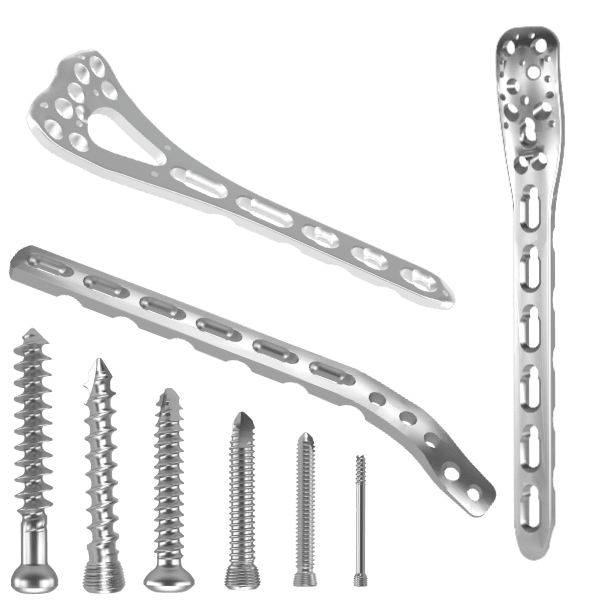
Types of Orthopedic Screws
Orthopedic screws are available in numerous designs.
1. Cortical Screws
Cortical screws are designed for fixation involving cortical bone and typically feature relatively fine threads compared with cancellous screw designs.
They may be used in various orthopedic fixation applications depending on the surgical technique and implant system.
2. Cancellous Screws
Cancellous screws are designed for applications involving cancellous or softer bone.
Their thread configuration is generally different from that of cortical screws.
The appropriate screw should always be selected according to the bone characteristics and intended fixation technique.
3. Locking Screws
Locking screws are designed to engage with compatible plate holes in a locking plate system.
The screw head and plate hole work together to create a fixed-angle relationship between the screw and plate.
This makes locking screws different from conventional screws that rely primarily on compression between the plate and bone.
4. Cannulated Screws
Cannulated screws have a hollow central channel that allows them to be guided over a guidewire during placement.
This design can assist with accurate positioning in certain orthopedic procedures.
Cannulated screws are available in different diameters and lengths.
5. Compression Screws
Compression screws are designed for fixation techniques where compression between selected bone fragments is required.
The exact mechanism depends on the screw design and surgical technique.
6. Headless Screws
Headless compression screws are designed without a conventional prominent screw head.
They may be used where a low-profile fixation solution is desirable, depending on the anatomical location and surgical indication.
Types of Orthopedic Plates
There are many different orthopedic plate designs.
1. Straight Plates
Straight plates have a relatively linear configuration and can be used where the bone anatomy allows a straightforward plate position.
They are available in different lengths, widths, thicknesses, and hole configurations.
2. Reconstruction Plates
Reconstruction plates are designed with characteristics that allow them to be contoured to certain anatomical structures.
They may be used when the bone has a complex shape and a standard straight plate does not provide the required fit.
3. Locking Plates
Locking plates contain specially designed holes that allow compatible locking screws to engage with the plate.
This creates a fixed-angle construct between the screw and plate.
Locking plate systems are available for different anatomical regions and fracture patterns.
4. Compression Plates
Compression plates are designed for fixation techniques where compression across selected bone fragments is part of the surgical objective.
The plate-hole geometry and screw placement technique determine how compression is achieved.
5. Anatomical Plates
Anatomical plates are designed to correspond to the general contour of a particular anatomical region.
Examples can include plates designed for areas such as:
- Distal radius
- Clavicle
- Distal femur
- Proximal tibia
- Ankle
- Humerus
- Pelvis
Exact designs and anatomical applications vary by manufacturer and implant system.
Orthopedic Screw and Plate Materials
Orthopedic implants are manufactured from materials selected for their mechanical and biological requirements.
Common implant materials can include:
Stainless Steel
Stainless steel has historically been widely used in orthopedic fixation systems.
Its characteristics can include mechanical strength and corrosion resistance.
Titanium and Titanium Alloys
Titanium-based materials are also commonly used in orthopedic implants.
They offer characteristics that can make them suitable for various implant applications.
The exact alloy and material grade should always be confirmed through the manufacturer’s technical documentation.
A product should not be described as a particular grade of titanium or stainless steel unless that specification has been verified.
Common Applications of Orthopedic Screws and Plates
Orthopedic screws and plates may be used in a wide range of surgical fixation procedures.
Applications can include:
- Fracture fixation
- Bone stabilization
- Reconstructive orthopedic surgery
- Joint-related procedures
- Long-bone fracture fixation
- Upper-extremity fixation
- Lower-extremity fixation
- Small-bone fixation
- Trauma surgery
The exact implant configuration depends on the patient’s anatomy, fracture characteristics, bone quality, and surgical plan.
Orthopedic Plates for Different Bones
Different anatomical regions require different plate configurations.
Clavicle Plates
Clavicle plates are shaped to accommodate the general anatomy of the clavicle.
They may include different hole arrangements and profiles depending on the implant system.
Distal Radius Plates
Distal radius plates are designed for fixation around the wrist region.
Their shape and hole arrangement are adapted to the anatomy of the distal radius.
Femur Plates
Femoral plates are available in different configurations for different regions of the femur.
Longer plates may be used where a larger fixation area is required.
Tibia Plates
Tibial plates are available for different portions of the tibia and can include anatomical and locking configurations.
Humerus Plates
Humeral plates are designed for fixation of fractures involving different regions of the upper arm bone.
Important Orthopedic Screw Specifications
When purchasing orthopedic screws, buyers should carefully check the product specifications.
Important details include:
- Screw diameter
- Screw length
- Thread type
- Thread pitch
- Head design
- Drive type
- Tip configuration
- Material
- Coating, if applicable
- Intended plate compatibility
- Implant system compatibility
A screw should not be selected solely on its overall appearance.
The exact dimensions and compatibility should be confirmed through the manufacturer’s documentation.
Important Orthopedic Plate Specifications
For orthopedic plates, important specifications can include:
- Overall plate length
- Plate width
- Plate thickness
- Number of holes
- Hole diameter
- Hole configuration
- Plate curvature
- Anatomical profile
- Screw compatibility
- Material
- Left/right configuration where applicable
These specifications help surgeons and procurement teams identify the correct implant for a particular fixation system.
Locking Plates vs Conventional Plates
One important distinction in orthopedic fixation is between locking plates and conventional plates.
A conventional screw generally holds the plate against the bone through the screw’s fixation and tightening.
A locking screw, when used with a compatible locking plate hole, engages with the plate itself to create a fixed-angle connection.
Therefore, locking screws and locking plates should generally be considered as a compatible system rather than interchangeable components.
The specific technique and indications should be determined by qualified orthopedic professionals.
What Makes a Good Orthopedic Screw?
Quality considerations for orthopedic screws can include:
Accurate Dimensions
The screw should correspond to the manufacturer’s stated diameter and length.
Consistent Threads
Thread geometry should be manufactured consistently according to the specified design.
Proper Head Design
The screw head should correspond to the intended plate or fixation system.
Appropriate Drive
The drive configuration should match the intended surgical instrumentation.
Surface Finish
The implant should have an appropriate and consistent surface finish.
Material Documentation
The manufacturer should provide appropriate material information.
Traceability
Professional implant products should have appropriate product identification and traceability according to the applicable purchasing and regulatory requirements.
What Makes a Good Orthopedic Plate?
Important quality characteristics can include:
Accurate Plate Shape
The plate should correspond to its specified anatomical or general configuration.
Consistent Hole Dimensions
The holes should be manufactured according to the intended screw compatibility.
Proper Surface Finish
The plate should have a consistent surface finish appropriate for its intended application.
Accurate Thickness
The actual plate thickness should correspond with the product specification.
Reliable Manufacturing
The plate should have consistent dimensions and construction.
Clear Product Identification
Professional suppliers should provide a product reference, model, dimensions, material information, and other applicable documentation.
How to Choose Orthopedic Screws and Plates
Hospitals, orthopedic surgeons, distributors, and procurement teams should consider several factors before purchasing.
1. Identify the Anatomical Application
First determine which bone and anatomical region the implant is intended for.
2. Check the Plate Design
Verify the plate shape, length, width, thickness, and hole configuration.
3. Select Compatible Screws
Confirm that the screw dimensions and design are compatible with the selected plate system.
4. Check the Material
Review the manufacturer’s material specification.
5. Verify Dimensions
Do not rely only on product names. Check the exact measurements.
6. Review Product Documentation
Depending on the market and purchasing environment, buyers may require technical documentation, traceability information, packaging details, and applicable regulatory documentation.
7. Confirm Packaging
Implant packaging should be checked according to the manufacturer’s supplied information.
8. Check Product Identification
Confirm manufacturer, catalog number, batch or lot information where applicable, and other product identification details.
Orthopedic Screws and Plates Specification Checklist
| Specification | What to Verify |
|---|---|
| Product category | Orthopedic implant |
| Implant type | Screw or plate |
| Intended application | Specific orthopedic procedure |
| Plate length | Exact manufacturer measurement |
| Plate width | Exact manufacturer measurement |
| Plate thickness | Exact manufacturer measurement |
| Number of holes | Product-specific |
| Hole configuration | Product-specific |
| Screw diameter | Exact measurement |
| Screw length | Exact measurement |
| Thread design | Product-specific |
| Head design | Product-specific |
| Material | Documented material |
| Screw compatibility | Compatible plate/system |
| Manufacturer | Company identification |
| Catalog number | Exact product reference |
| Lot/Batch information | Where applicable |
| Packaging | Product-specific information |
Care and Handling of Orthopedic Implants
Orthopedic screws and plates intended for implantation should be handled according to the manufacturer’s instructions and the applicable healthcare facility procedures.
Before use, appropriate personnel should inspect the implant packaging and product condition.
Depending on the product and manufacturer, inspection may include checking:
- Packaging integrity
- Product identification
- Surface condition
- Plate shape
- Screw threads
- Screw head
- Signs of damage
- Corrosion or contamination
- Correct size and configuration
Damaged or compromised products should be managed according to the facility’s established procedures and manufacturer guidance.
Orthopedic Screws and Plates for Surgical Instrument Sets
Orthopedic fixation systems are often used alongside specialized surgical instruments.
Depending on the system, associated instruments may include:
- Drill guides
- Drill bits
- Screwdrivers
- Depth gauges
- Plate holders
- Plate benders
- Bone reduction forceps
- Taps
- Countersinks
- Measuring instruments
The exact instruments required depend on the implant system and surgical technique.
For procurement teams, compatibility between implants and their associated instruments is an important consideration when preparing a complete orthopedic fixation set.
Frequently Asked Questions
What are orthopedic screws and plates?
Orthopedic screws and plates are surgical implants used to help stabilize and fix bones during orthopedic procedures, particularly fracture fixation.
What is an orthopedic plate used for?
An orthopedic plate is positioned along a bone and can be secured using compatible screws to provide stabilization during a fixation procedure.
What are orthopedic screws used for?
Orthopedic screws can be used to secure plates to bone, maintain fixation between bone fragments, or provide fixation in other orthopedic procedures depending on their design.
What is a locking plate?
A locking plate is an orthopedic plate with specially designed holes that allow compatible locking screws to engage with the plate and create a fixed-angle connection.
What is the difference between locking and conventional screws?
Locking screws are designed to engage with compatible locking plate holes, whereas conventional screws generally rely on the screw’s fixation to secure the plate and bone relationship.
What materials are orthopedic screws and plates made from?
Common materials include stainless steel and titanium-based materials. The exact material and grade should be confirmed from the manufacturer’s documentation.
Are all orthopedic screws compatible with all plates?
No. Screw diameter, head design, thread configuration, and plate-hole design can differ between systems. Compatibility should always be confirmed by the manufacturer.
How are orthopedic plates selected?
Selection depends on the anatomical region, fracture characteristics, plate dimensions, hole configuration, material, and the surgical fixation strategy.
What should buyers check before purchasing orthopedic implants?
Buyers should check dimensions, material, screw/plate compatibility, manufacturer, catalog number, packaging, traceability information, and applicable technical documentation.
Conclusion
Orthopedic screws and plates are fundamental components of modern orthopedic fixation systems. Plates provide a structural surface for fixation along the bone, while screws secure the implant and can provide fixation between selected bone structures depending on their design.
Different types of screws and plates are available, including cortical screws, cancellous screws, locking screws, cannulated screws, compression screws, straight plates, reconstruction plates, locking plates, compression plates, and anatomical plates.
Because orthopedic implants are available in many different sizes and configurations, selecting the correct product requires attention to anatomical application, plate dimensions, screw diameter, screw length, thread design, hole configuration, material, compatibility, manufacturer, and product documentation.
For hospitals, orthopedic surgeons, distributors, and procurement teams, accurate product specifications and compatibility information are essential when building orthopedic fixation systems.
The specific implant selection and surgical technique should always be determined by qualified orthopedic professionals according to the patient’s condition, surgical requirements, applicable clinical protocols, and manufacturer instructions.
https://loharorthopedic.com/product-category/orthopaedic-instruments
About author

Add comment